 "/assets/img/senior-therapy.webp", "alt"=>"Senior therapy and balance training"}" alt="WHO’s Intrinsic Capacity Framework Explained">
WHO’s Intrinsic Capacity Framework Explained
Navigating Aging: Insights from the WHO’s Framework
The World Health Organization’s Intrinsic Capacity Framework offers a comprehensive approach to understanding and enhancing the well-being of older adults. This framework emphasizes the importance of intrinsic capacity, which encompasses an individual’s physical and mental abilities.
Medical Disclaimer: This content is for informational and educational purposes only. It does not replace professional medical advice, diagnosis, or treatment. Always consult a qualified healthcare provider regarding any medical condition.
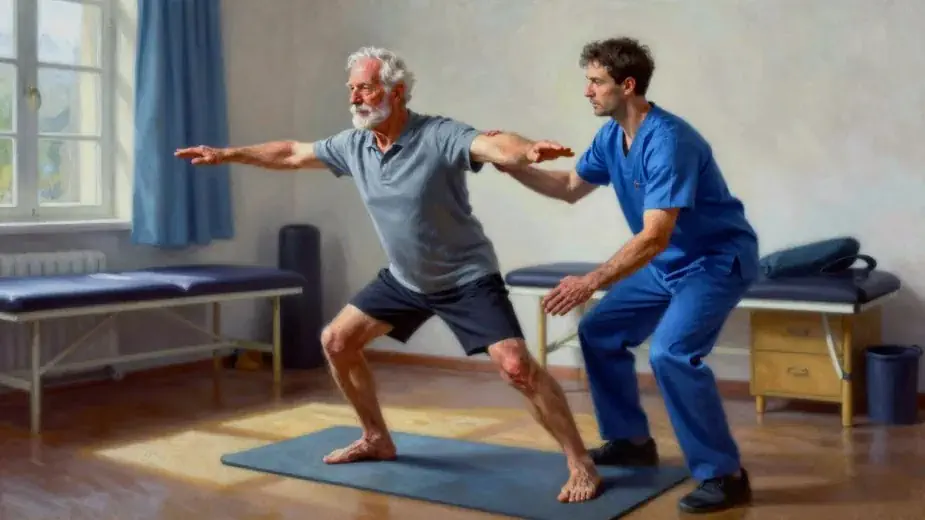
Figure 1: In a brightly lit equipment room, an elderly man engages in balance training under the guidance of his physical therapist.
What Is Intrinsic Capacity?
The WHO defines intrinsic capacity (IC) as the composite of all the physical and mental capacities that an individual can draw on at any point in time. Rather than focusing solely on diseases (e.g., arthritis, diabetes), this framework focuses on what a person can actually do.
The Fundamental Shift
- Capacity over Diagnosis: Two people with the same diagnosis can function very differently.
- Early Detection: Functional decline often begins before a diagnosable disease.
- Independence: Preserving capacity delays disability and dependence.
Intrinsic Capacity vs. Functional Ability
WHO distinguishes between two closely related concepts:
- Intrinsic Capacity: What your body and brain are capable of.
- Functional Ability: What you are able to do in your real environment.
Functional Ability is shaped by your IC plus your environment (housing, walkability, social support). This interaction is central to the global aging policy from 2021–2030.
The Five Domains of Intrinsic Capacity
WHO operationalizes intrinsic capacity into five measurable domains:
1. Locomotor Capacity (Movement & Strength)
- Includes: Muscle strength, balance, gait speed, and mobility.
- Why it matters: Declines here are the strongest predictors of falls and loss of independence.
2. Vitality (Energy & Physiologic Reserves)
- Includes: Nutrition status, metabolic health, and muscle mass.
- Context: Researchers emphasize nutrition as the foundation that underpins all other capacities.
3. Cognitive Capacity
- Includes: Memory, attention, and executive function (planning/decision-making).
- Note: Decline can occur even in the absence of dementia and predicts future functional impairment.
4. Psychological Capacity
- Includes: Emotional regulation, mood stability, and stress resilience.
- Impact: Depression can significantly accelerate decline across other IC domains.
5. Sensory Capacity (Vision & Hearing)
- Includes: Visual acuity and hearing function.
- Risk: Untreated sensory loss is associated with cognitive decline and increased mortality risk.
Domain-by-Domain Therapy Mapping
1. Locomotor Capacity → Physical Therapy
| IC Finding | Best-Matched Intervention | | :— | :— | | Reduced strength | Progressive resistance training | | Poor balance | Balance & perturbation training | | Slow gait speed | Task-specific gait training | | Functional difficulty | Sit-to-stand and stair work |
2. Vitality → Nutrition + Exercise Synergy
| IC Finding | Best-Matched Intervention | | :— | :— | | Low muscle mass | Resistance training + protein optimization | | Poor endurance | Low-intensity aerobic conditioning | | Nutritional risk | Dietitian referral + strength training | | Frailty | Multicomponent exercise |
3. Cognitive Capacity → Cognitive-Physical Therapy
| IC Finding | Best-Matched Intervention | | :— | :— | | Mild cognitive decline | Dual-task training (e.g., walking while counting) | | Executive dysfunction | Movement + cognitive challenges | | Reaction time issues | Balance + cognitive load exercises |
4. Psychological Capacity → Behavioral Therapy
| IC Finding | Best-Matched Intervention | | :— | :— | | Depression | Structured exercise + behavioral activation | | Anxiety | Predictable routines + graded exposure | | Low confidence | Supervised therapy with feedback | | Fear of falling | Balance training + confidence-building tasks |
FAQ: Understanding the Framework
What is the WHO’s Intrinsic Capacity Framework?
It is a tool to measure physical and mental capabilities. It assesses cognitive, psychological, and physical functions to help healthcare professionals develop personalized care plans for healthy aging.
How does it support older adults?
By identifying areas where assistance is needed early, the framework helps caregivers develop targeted strategies to maintain independence and reduce the risk of disability.
Why is this important for “Healthy Aging”?
It recognizes that physical, mental, and social factors all influence health. Addressing these factors together helps older adults manage chronic conditions more effectively.
Summary for the Proactive Patient
The WHO framework reframes aging as a dynamic, modifiable process. By focusing on strength, cognition, vitality, mood, and sensory health—before disability occurs—it empowers you to act earlier and more precisely.
March 2026 Clinical Update: Psoriasis is now managed as a systemic inflammatory event. Clinical targets emphasize metabolic support with high-quality protein (1.2–1.6 g/kg) to maintain skin cell turnover and lean muscle mass.