Vitamin D and Sarcopenia: The 2026 Muscle Health Update
A patient-researcher update on how Vitamin D deficiency accelerates sarcopenia and the modifiable 'Triad' of muscle health.
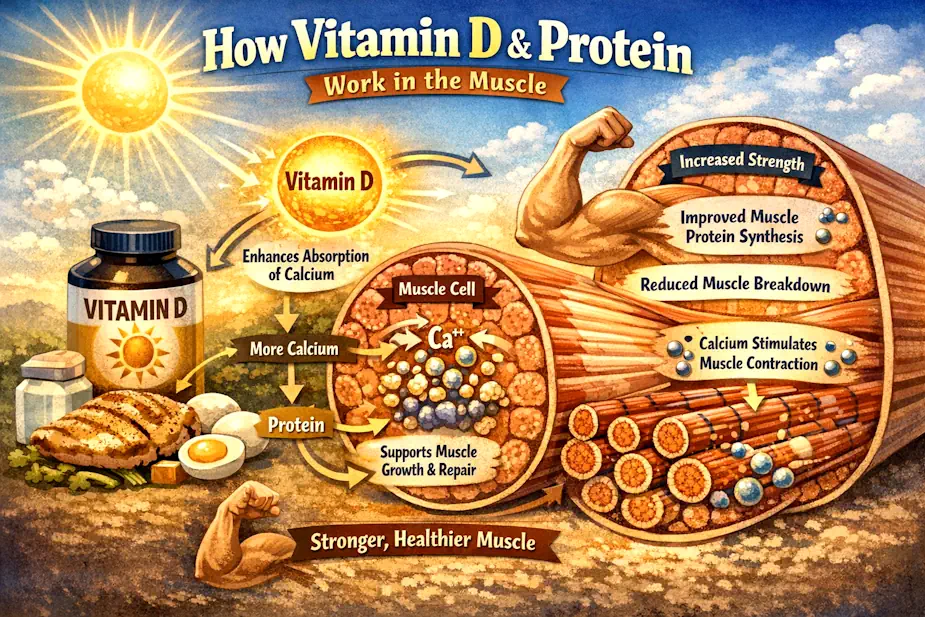
## 🧬 1. How Vitamin D Works in Muscle Vitamin D supports skeletal muscle through **genomic and non‑genomic pathways**: ### 🔑 Vitamin D Receptor (VDR) Skeletal muscle expresses the VDR. When activated, it promotes: - Protein synthesis - Muscle cell differentiation - Fiber regeneration and repair ---  Deficiency dampens these signals, contributing to progressive atrophy. --- ### ⚡ Calcium Homeostasis Vitamin D regulates calcium flux inside the sarcoplasmic reticulum. Low levels lead to: - Slower contraction velocity - Reduced peak force - Early functional weakness—often *before* visible muscle loss ### 🔋 Mitochondrial Support Vitamin D supports oxidative phosphorylation. Because sarcopenia tracks closely with mitochondrial aging, adequate levels help preserve **muscle energy capacity**. --- ## 🔁 2. The Muscle‑Strength‑Deficiency Loop In adults over 65, Vitamin D deficiency tends to follow a predictable pattern: ### 🎯 Selective Type II Fiber Loss Fast‑twitch fibers are disproportionately affected, impairing: - Balance - Gait speed - Fall prevention ### 🧍♂️ The Inactivity Spiral Weakness reduces activity. Less activity worsens muscle loss and Vitamin D utilization—**a self‑reinforcing decline** toward frailty. --- ## ⏳ 3. Aging‑Related Risk Amplifiers Several age‑related changes increase vulnerability: - ☀️ **Reduced Skin Synthesis** Cutaneous Vitamin D₃ production declines by *up to 75%* after age 65. - 🧪 **Impaired Activation** Aging liver and kidney function reduces conversion to active Vitamin D. - 🔥 **Inflammaging** Chronic low‑grade inflammation downregulates the VDR—blunting muscle response *even when serum levels appear “normal.”* --- ## 💊 4. Supplementation: What Actually Helps? ### ✅ Threshold Matters Vitamin D supplementation shows the greatest benefit in individuals with: - **25(OH)D < 20 ng/mL (50 nmol/L)** Those already sufficient rarely gain additional muscle mass from supplementation alone. ### 🔺 The Muscle Health Triad Vitamin D is **not a stand‑alone treatment**. Its true value is catalytic—supporting: > **Vitamin D + Resistance Training + Adequate Protein** Together, they enable effective muscle remodeling. --- ## 🩺 Key Clinical Takeaways | 🔍 Question | ✅ Answer | |---|---| | **What’s the link?** | Deficiency weakens Type II fibers essential for balance and fall prevention | | **Primary mechanisms** | Reduced VDR signaling, impaired calcium handling, mitochondrial decline | | **Clinical impact** | Weakness → inactivity → accelerated muscle loss | | **Action step** | Screen Vitamin D in adults >65 with falls, gait changes, or low grip strength | > **Research Note:** > Vitamin D is a *catalyst*, not a cure‑all. Best outcomes occur when paired with resistance training and ~**1.2 g/kg/day protein**. --- ## 🏋️ Resistance Training: Still the Cornerstone Even light resistance training: - Rebuilds muscle - Improves balance - Enhances bone density - Supports glucose control and cardiovascular health ✅ **Two sessions per week** can meaningfully slow sarcopenia. --- ## 🍗 Protein Needs in Sarcopenia Older adults require **more protein** to overcome anabolic resistance. ### ⭐ Daily Targets - **1.0–1.2 g/kg/day** (general aging) - **1.2–1.5 g/kg/day** (sarcopenia or high fall risk) **Examples** - 150 lb adult → **68–82 g/day** - 180 lb adult → **82–99 g/day** ### 🍽️ Per‑Meal Strategy - **25–40 g protein per meal** - or **0.4–0.6 g/kg per meal** ### 🌱 Leucine Target Aim for **2.5–3.0 g leucine per meal** Best sources: whey, eggs, chicken, Greek yogurt, pea protein ### 🧃 Timing Tips - Spread protein over **3–4 meals** - Prioritize **breakfast protein** - Pair intake with resistance exercise - Consider evening protein for overnight repair --- ## 🛒 Muscle Health Grocery Checklist > **Take your protein and Vitamin D targets to the store.** ✅ Lean proteins ✅ Dairy or fortified alternatives ✅ Eggs ✅ Fatty fish ✅ Whey or plant protein powder *(Tip: print this section for clinic or home use)* --- ## 🧠 Summary In adults over 65, Vitamin D is a *permissive factor* for strength, balance, and independence. It bridges nutrition and performance—ensuring muscle remains responsive to exercise and protein. --- ## 👤 About the Researcher **Tommy T. Douglas** is an independent health researcher and patient advocate. A heart‑attack survivor (2008) managing Type 2 Diabetes with Metformin and GLP‑1 therapy, he focuses on translating complex medical research into actionable guidance for older adults. --- ## 📚 Clinical References 1. Wang L. *et al.* **Scientific Reports** (2026). https://doi.org/10.1038/s41598-026-47141-1 2. Fuentes‑Barría H. *et al.* **Biomedicines** (2025). doi:10.3390/biomedicines13081863 3. Kuwabara A. *et al.* **Curr Opin Clin Nutr Metab Care** (2024). 4. British Geriatrics Society (2026). 5. Kawahara T. *et al.* **The Lancet Healthy Longevity** (2024).
This post is licensed under CC BY 4.0 by the author.