Vitamin D and Sarcopenia: The 2026 Muscle Health Update
A research update on how Vitamin D deficiency accelerates muscle loss in seniors.
Sarcopenia is no longer viewed as an inevitable consequence of aging. It is a modifiable metabolic condition — and Vitamin D status is one of its most overlooked contributors.
As both clinician and researcher, I’ve seen the pattern repeatedly: subtle gait slowing, increased chair‑rise difficulty, recurrent “minor” falls. In many cases, Vitamin D deficiency is part of the physiology driving the decline.
Here’s what the 2026 evidence tells us.
🧬 1. How Vitamin D Works in Muscle
Vitamin D supports skeletal muscle through genomic and non‑genomic pathways, influencing strength, recovery, and fiber composition.
✅ Genomic Effects (Slow but Foundational)
Vitamin D binds to the Vitamin D Receptor (VDR) in muscle cells, altering gene transcription involved in:
- Muscle protein synthesis
- Mitochondrial function
- Myocyte differentiation
- Anti‑inflammatory signaling
Low Vitamin D reduces VDR activation, dampening anabolic signaling and accelerating muscle breakdown.
⚡ Non‑Genomic Effects (Fast and Functional)
Vitamin D also influences:
- Calcium transport into muscle cells
- Excitation–contraction coupling
- Neuromuscular coordination
Deficiency impairs calcium handling, which reduces peak power output — particularly in Type II fast‑twitch fibers.
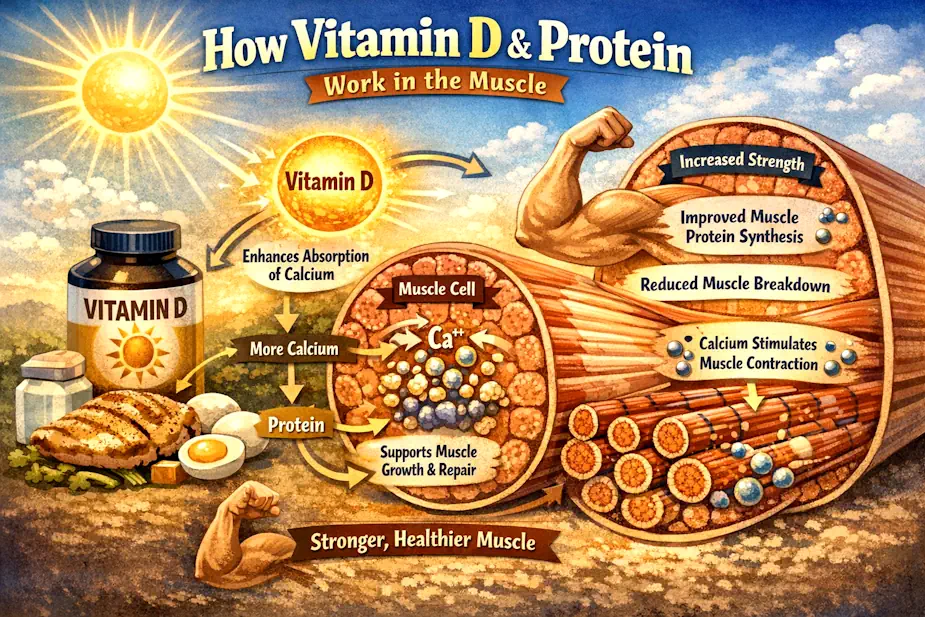 The Vitamin D Muscle Triad: VDR signaling, calcium handling, and mitochondrial integrity. Deficiency dampens these signals, contributing to progressive atrophy.
🧠 2. Why Type II Fibers Matter Most
Sarcopenia does not affect all muscle fibers equally.
- Type I fibers → endurance, posture
- Type II fibers → power, balance correction, fall prevention
Vitamin D deficiency preferentially weakens Type II fibers — the very fibers needed to prevent falls. This explains why deficiency often presents clinically as:
- Slower gait speed
- Reduced grip strength
- Impaired sit‑to‑stand performance
- Increased fall risk
In short: Vitamin D deficiency often manifests first as power loss, not just mass loss.
🔬 3. The Inflammation–Vitamin D Loop
Chronic low‑grade inflammation (“inflammaging”) suppresses VDR expression.
Low Vitamin D → increased inflammatory cytokines → further muscle catabolism.
This bidirectional loop accelerates sarcopenia in:
- Sedentary adults
- Patients with obesity
- Chronic kidney disease
- Diabetes
- Post‑hospitalization deconditioning
Vitamin D sufficiency appears to buffer this inflammatory amplification.
🩺 4. Screening & Lab Considerations
Who to Screen
- Adults >65 with gait instability
- Recurrent falls
- Grip strength decline
- Post‑fracture patients
- Nursing home residents
- Patients with malabsorption
Target Serum 25(OH)D Levels
| Category | Serum 25(OH)D |
|---|---|
| Deficient | <20 ng/mL |
| Insufficient | 20–29 ng/mL |
| Muscle‑optimized range | 30–50 ng/mL |
Levels above 50 ng/mL do not appear to confer additional muscle benefit and may increase risk if excessive.
🏋️ 5. Vitamin D Is Necessary — But Not Sufficient
Supplementation alone does not reverse sarcopenia.
It restores biological readiness — but mechanical stimulus is required.
The Muscle Health Formula:
- ✅ Vitamin D sufficiency
- ✅ Progressive resistance training (2–3x/week)
- ✅ Adequate protein intake (~1.2 g/kg/day for older adults)
- ✅ Leucine‑rich meals (~2.5–3 g leucine per meal)
Vitamin D enhances responsiveness to resistance training. Without loading stimulus, its effect plateaus.
📊 6. What the 2026 Evidence Suggests
Recent meta‑analyses show:
- Small but significant improvement in lower‑extremity strength in deficient older adults
- Reduced fall risk when baseline levels are low
- Minimal benefit in already sufficient individuals
Translation: Correct deficiency. Don’t megadose sufficiency.
⚠️ Clinical Pitfalls
- Annual high‑dose bolus Vitamin D may increase falls.
- Low albumin can distort total 25(OH)D interpretation.
- Sarcopenic obesity may mask muscle loss under preserved body weight.
- Functional testing (gait speed <0.8 m/s, grip strength decline) is often more telling than BMI.
🧾 Key Clinical Takeaways
| 🔍 Question | ✅ Answer |
|---|---|
| What’s the link? | Deficiency weakens Type II fibers essential for balance and power |
| Primary mechanisms | Reduced VDR signaling, impaired calcium handling, inflammatory amplification |
| Who benefits most? | Older adults who are truly deficient (<20 ng/mL) |
| Action step | Screen Vitamin D in adults >65 with gait changes or recurrent falls |
| Adjunct strategy | Pair supplementation with resistance training + ~1.2 g/kg/day protein |
Research Note:
Vitamin D is a catalyst, not a cure‑all. It restores the muscle’s ability to respond — but hypertrophy still requires mechanical tension and adequate amino acids.
🔄 The Bottom Line
Sarcopenia is not simply muscle loss — it is signaling loss.
Vitamin D deficiency accelerates that signaling failure.
Correcting deficiency will not replace the barbell — but it may determine whether the barbell works.
Muscle aging is modifiable. Screening is simple.
The opportunity window is earlier than we think.