Food Additives & Type 2 Diabetes: Identifying Metabolic Disruptors
A 2026 clinical update on how ultra-processed food additives disrupt insulin signaling and degrade gut health.

Convenience is a high-value currency in 2026, but it often comes at a hidden metabolic cost. As an independent researcher managing Type 2 Diabetes myself, I’ve realized that “eating healthy” isn’t just about counting calories—it’s about identifying the Additives that disrupt our insulin signaling and degrade our gut health.
Medical Disclaimer: This guide is for educational purposes. Additive research is often observational; use this data to inform your conversations with a clinical nutritionist or your GP.
Figure 1: Label Literacy is a critical skill for managing glucose stability in a landscape of ultra-processed foods.
The “Hidden Bridge” to Insulin Resistance
Type 2 Diabetes occurs when the body loses its Metabolic Flexibility—the ability to process glucose efficiently. Recent 2026 clinical syntheses suggest that ultra-processed food additives act as “clogs” in this system:
- Gut Barrier Permeability: Certain additives thin the protective mucus lining of the gut, allowing pro-inflammatory molecules into the bloodstream.
- Hormonal Mimicry: Synthetic sweeteners and stabilizers can “trick” the pancreas into releasing insulin at the wrong times, leading to chronic resistance.
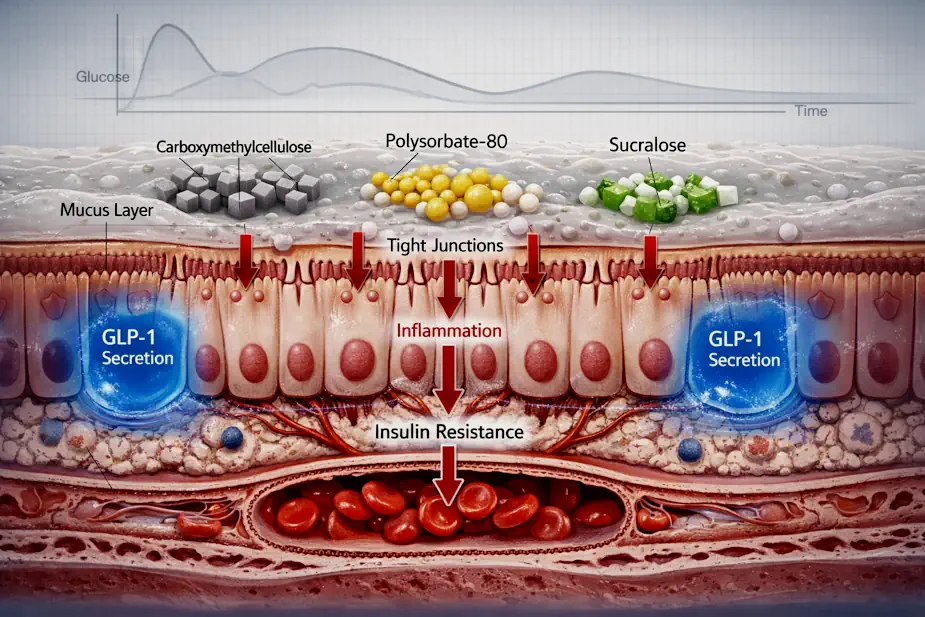 Figure 2: Food additives like CMC, polysorbate‑80, and sucralose can disrupt the gut barrier and alter GLP‑1 signaling-a hidden pathway linking ultra‑processed foods to Type 2 diabetes risk. —
🔬 March 2026 Clinical Synthesis: The “E-List” to Watch Data from the NutriNet-Santé cohort has pinpointed seven specific emulsifiers that significantly correlate with T2D risk. Scan your labels for these:
- E471 (Mono- and diglycerides): Linked to a 15% higher risk in long-term studies.
- Carrageenan & Guar Gum: Often found in dairy alternatives; can trigger intestinal inflammation.
- Nitrites (Sodium Nitrite): Found in processed meats; categorized as metabolic disruptors.
Tactical Label Literacy: The Douglas Method
To advocate for your metabolic health, you must look past the “front of the box” marketing. Flip the package and use the Five-Ingredient Rule.
Researcher Tip: If the label contains Tripotassium Phosphate or Sodium Citrate in the top five ingredients, it is likely a “High-Disruption” food. Opt for whole-food alternatives to maintain your glucose stability.
🗣️ The Patient Translation: Food Science vs. Reality
| The Term | What it Actually Means | Advocacy Action |
|---|---|---|
| Emulsifiers | “Glue” that keeps oil and water from separating. | Limit to protect your Gut Barrier and reduce systemic fire. |
| Non-Nutritive Sweeteners | Artificial sugars (Sucralose/Aspartame) with zero energy. | Monitor your CGM; these can still trigger insulin spikes. |
| Nitrosamines | Compounds formed when nitrites in meat are cooked at high heat. | Swap processed meats for lean, whole proteins. |
⚠️ The “Red Flag” Translation: If a product is labeled “Natural” but contains Carrageenan or Maltodextrin, translate that to: “This is an ultra-processed food with a health halo.”
🩹 March 2026 Advocacy: Psoriasis & Metabolic Health In 2026, we manage Psoriasis as a systemic metabolic event. For those of us with T2D and skin inflammation, our target protein intake is now strictly 1.2–1.6 g/kg to maintain cell turnover while stabilizing glucose. High blood pressure targets now align at <130/80 mmHg.
About the Researcher
Tommy T. Douglas is an independent health researcher and heart attack survivor (2008). He manages Type 2 Diabetes with Metformin and GLP-1 therapy and specializes in translating clinical data for senior patient advocacy.
| Explore more by topic: Pathology | Metabolism | GLP-1/Ozempic | Liver |
Sources and Clinical Citations
- Scientific Reports (2025): Emulsifiers and the T2D Correlation in NutriNet-Santé.
- Harvard T.H. Chan: Processed Foods and Metabolic Health (2026 Update).
- American Diabetes Association: Understanding Type 2 Diabetes Pathogenesis.
| _Provided by Tommy T. Douglas | AgingHealth.website_ |