Colon Cancer: From Genetic Roots to Precision Breakthroughs
Exploring the Swedish MakA toxin breakthrough, the PIK3 signaling pathway, and tactical screening for high-risk families.
Colon Cancer: From Family Risk to the Swedish “Smart Toxin” Breakthrough
For many families, colon cancer is a shadow that looms over generations. Having lost my first wife to this disease in her mid-thirties, and now seeing my daughter cross the age-40 threshold, I view this research not as abstract science, but as a tactical defense plan.
Medical Disclaimer: This content is for informational and educational purposes only. It does not replace professional medical advice, diagnosis, or treatment. Always consult a qualified healthcare provider regarding any medical condition.
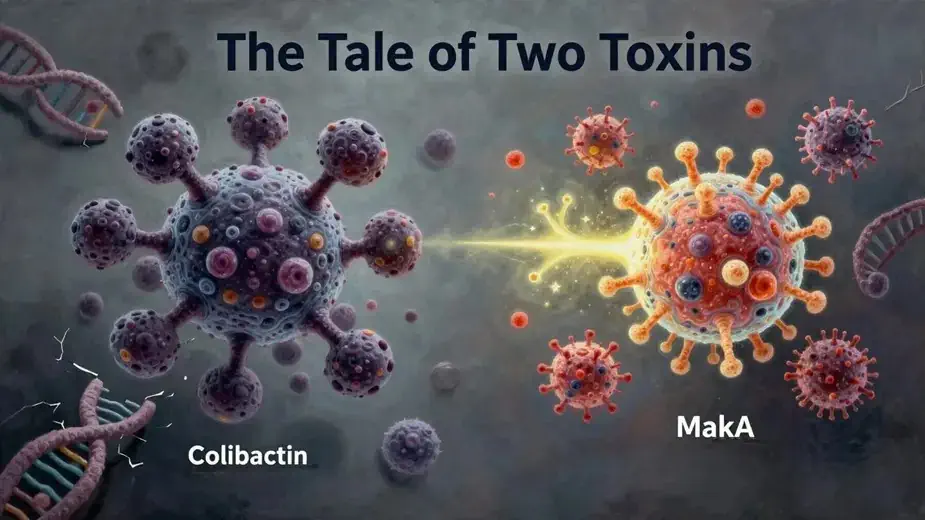
Figure 1: The Tale of Two Toxins: Colibactin acts as a DNA-damaging “villain,” while MakA emerges as a “hero” that selectively targets tumor cells.
The 2026 Swedish Breakthrough: The MakA Toxin
Researchers at Umeå University have discovered a potential “smart bomb” for colorectal cancer (CRC) utilizing a toxin called MakA, produced by the cholera bacteria.
- Targeted Lethality: Unlike traditional chemotherapy, MakA ignores healthy cells and specifically accumulates inside tumor cells.
- The Mechanism: Once inside, it triggers a “self-destruct” sequence (apoptosis) and alerts the immune system to attack.
- Safety Profile: Early 2026 data shows effective tumor shrinkage without the systemic side effects typical of traditional treatments.
🧬 Precision Prevention: The ALASCCA Trial
The ALASCCA Trial from the Karolinska Institutet is a discovery that families should discuss with their doctors today.
The Key Discovery: Patients with a mutation in the PIK3 signaling pathway (approximately 40% of patients) see a massive reduction in recurrence when taking daily low-dose aspirin. Biomarker testing for this mutation is now a critical step in post-surgical care.
🧬 Family-History Screening Path
Since early-onset colon cancer is on the rise, we must follow the 10-Year Rule for high-risk families.
- The 10-Year Rule: Screening should begin at age 40, or 10 years earlier than the youngest diagnosis in the family—whichever comes first.
What to Ask Your Specialist:
- “Is there evidence of Lynch Syndrome (MLH1, MSH2, MSH6, PMS2 mutations)?”
- “Can we perform a PIK3 Mutation test to see if low-dose aspirin is a viable adjunct?”
- “Is ctDNA (Liquid Biopsy) appropriate for monitoring between my colonoscopies?”
Treatment Options: The 2026 Targeted Era
| Modality | Description | 2026 Highlight |
|---|---|---|
| Immunotherapy | Trains the immune system to attack. | Triple-punch combo (Chemo + Bev + Atezo). |
| Targeted Therapy | Blocks specific mutations (KRAS/BRAF). | Adagrasib approval for KRAS-G12C mutations. |
| Precision Surgery | Robotic-assisted removal. | “Watch-and-Wait” for complete responders. |
🏠 Post-Surgical Recovery Tip
Robotic-assisted surgery allows for faster discharge, but “Home Readiness” is still the priority. Before returning home, use our Seniors Home Safety Checklist to audit your bathroom for grab bars and clear your hallways to prevent post-op falls.
🔬 Clinical Synthesis: March 2026 Update
- Protein Targets: To maintain the lean mass required for treatment resilience, seniors should aim for 1.2–1.6 g/kg of high-quality protein (USDA 2026).
- Blood Pressure: Maintaining a systemic BP of <130/80 mmHg ensures optimal vascular delivery of targeted therapies.
- Vanderbilt Genetic Map (Feb 2026): 95 novel risk genes have been identified, moving us toward a future where genetic profiles dictate personalized screening intervals.
🧬 Colon Health Defense Checklist
- 10-Year Rule: Is my scope scheduled 10 years prior to my relative’s diagnosis age?
- Lynch Syndrome: Have I been tested for genetic DNA repair mutations?
- Biomarker Testing: If a polyp is found, will it be tested for PIK3CA?
- Metabolic Support: Am I optimizing Vitamin D3 and gut prebiotics to support the microbiome?
About the Researcher
Tommy T. Douglas is an independent health researcher and patient advocate. A survivor of a major heart attack, he specializes in translating complex genomic data into actionable health literacy for seniors and high-risk families.
Heart | Metabolism | Brain | Liver
📘 Related Patient Resources
- Seniors Home Safety Checklist: Essential for post-surgical recovery and TBI prevention.
- How We Research: Learn more about our clinical verification process and 2026 standards.
Beginner’s Guide to Diabetes: Managing metabolic health to support cancer resilience.
Glossary & Sources
- MakA Toxin: A Swedish-researched cholera protein that selectively kills tumors.
- ctDNA: A “Liquid Biopsy” that catches recurrence before traditional scans.
- Sources: Nature Communications (Umeå Study, Jan 2026); ALASCCA Trial (Karolinska, 2026); ASCO GI Symposium (Feb 2026).