Systemic Inflammation in Psoriasis: Beyond the Skin
Why psoriasis is a chronic systemic disease: Exploring how inflammatory cytokines impact the heart, liver, and metabolic function.
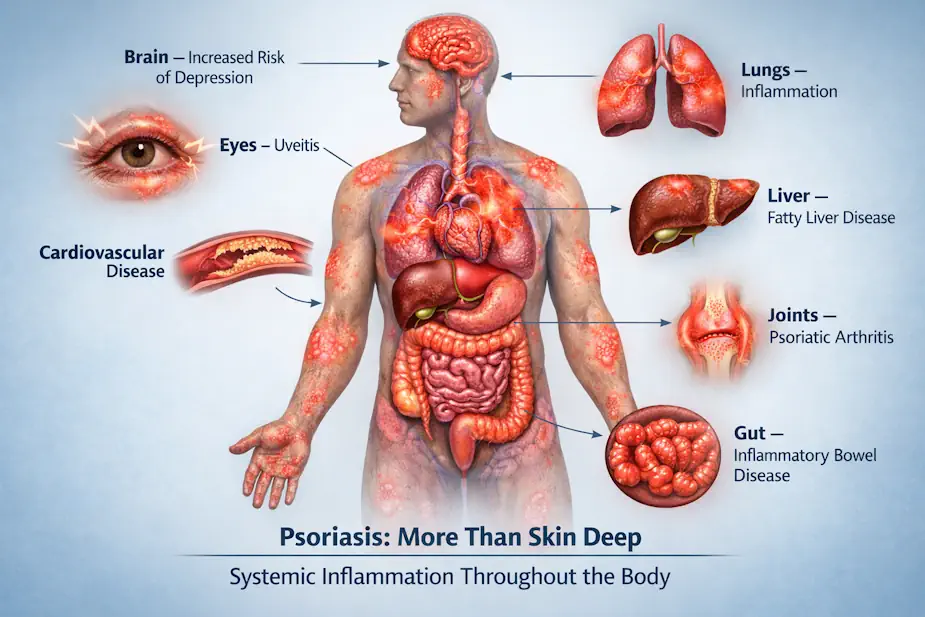
Why Psoriasis Is More Than a Skin Disease
Psoriasis has long been misunderstood as a condition limited to the skin. Modern clinical research shows that psoriasis is a chronic systemic inflammatory disease. It is a “fire” that starts in the immune system and spreads through the Vascular Bridge, impacting the heart, metabolism, and joint integrity.
Medical Disclaimer: This content is for informational and educational purposes only. It does not replace professional medical advice, diagnosis, or treatment. Always consult a qualified healthcare provider regarding any medical condition.
Figure 1: Psoriasis inflammation travels through the bloodstream to impact cardiovascular health and metabolic function.
What Is Systemic Inflammation?
Systemic inflammation occurs when inflammatory signals (cytokines) circulate throughout the body rather than remaining localized in the skin. In psoriasis, immune dysregulation leads to persistent activation of these pathways, even when skin symptoms appear mild.
The Cytokine “Messengers”
Psoriasis is driven by an overproduction of specific proteins that act as inflammatory triggers:
- TNF-α (Tumor Necrosis Factor): A major driver of joint damage and endothelial dysfunction.
- IL-17 and IL-23: The primary targets of modern biologic therapies; these cytokines promote the rapid skin cell turnover that creates plaques.
- IL-6: A marker often linked to the “sugar spikes” seen in Type 3 Diabetes.
The Internal Impact: A Multi-Organ View
1. Cardiovascular System
Chronic inflammation damages the delicate inner lining of the blood vessels. This accelerates atherosclerosis and increases the risk of heart attack and stroke. As a survivor of a 2008 heart attack, I monitor these inflammatory markers as closely as my cholesterol.
2. Metabolic System
Inflammation interferes with how the body uses insulin. This creates a cycle of insulin resistance, making it harder to maintain stable glucose levels.
3. Liver and Kidney Health
The liver often bears the brunt of systemic stress, leading to a higher risk of Non-Alcoholic Fatty Liver Disease (NAFLD). Proactive screening for liver enzymes is essential for anyone with moderate-to-severe psoriasis.
🎯 March 2026 Clinical Update: Resilience Standards
- Protein Support: To maintain skin cell turnover and prevent muscle wasting (sarcopenia) caused by chronic inflammation, seniors must target $1.2\text{–}1.6 \text{ g/kg}$ of high-quality protein (USDA 2026).
- Vascular Integrity: Maintain a blood pressure target of $<130/80 \text{ mmHg}$. This protects the vessels from the “turbulent flow” caused by inflammatory plaque buildup.
- Inflammatory Rule: Skin severity does not always reflect internal inflammation levels. Even mild skin symptoms can hide significant vascular risk.
🧐 Psoriasis & Inflammation FAQ
Can mild psoriasis cause internal damage?
Yes. Studies show that even patients with mild skin involvement can have elevated inflammatory markers (like hs-CRP) that contribute to cardiometabolic risk.
How do biologics help with internal inflammation?
Biologics act like a “fire extinguisher” for specific cytokines. By blocking TNF-α or IL-17, these therapies can reduce vascular inflammation and potentially lower the risk of a second cardiovascular event.
What lifestyle changes reduce systemic fire?
Following the Big 6 Pillars—specifically weight management and an anti-inflammatory diet—can significantly reduce the overall inflammatory load on your body.
About the Researcher
Tommy T. Douglas is an independent health researcher and patient advocate. A survivor of a major heart attack who manages Type 2 Diabetes, he specializes in translating complex immunological data into actionable health literacy for the aging population.
🧩 Clinical Research Glossary
Scientific Sources
- Lancet: Systemic inflammation and cardiovascular comorbidity in psoriasis.
- JAMA: Psoriasis and cardiovascular disease.
- J Am Acad Dermatol: Psoriasis and comorbid diseases.